
A modern cacophony.
A (quiet) plea for more silent, mindful spaces.

All the world feels like a cacophony of sound.
One day last week, on a warm, sunny afternoon, I thought to move outdoors. The temperatures were unseasonably pleasant and a (very) cold week was forecasted, so I wanted to enjoy it while I could. I had been reading “A Room with a View” and took it with me, but, reading in my backyard proved more challenging than expected: the incessant hum of leaf blowers, lawn mowers, and a neighbour using a band saw cascaded through the air, intermingled with the faint drone of highway traffic. So - I bring it indoors, brew a cup of coffee and sit on my office couch, but as I settle in and bring my focus to the page, I realise the exterior soundtrack also permeates my windows.
Usually, I wouldn’t pick up on the bothersome symphony of my street, but when I am seeking quiet and earnest focus, it’s all too obvious.
You might say, “My friend, you need a home in the country or a secluded cabin to call your own.” And, I would agree. Our public spaces (and at times, my densely populated neighbourhood) have become inundated by a modern cacophony of noise.
This also got me thinking about the constant streaming of music most everywhere we go.
You can’t procure your weekly groceries without being subjected to the best of the “80’s, 90’s and today”, and it’s unlikely that your weekend visit to a café will be very hushed without some preparedness on your part.
Each time I go out, my only solution is to to pop in a pair of Loops earplugs (which are well worth the money…) or to insert my AirPods and activate noise cancellation as I queue the playlist of my choosing. Unfortunately though, since Classical music is my go-to when reading or writing, even at higher volumes the outside world still seeps in at times. I enjoy listening to music or a podcast while out and about, but would still appreciate being able to exist in a public space without cramming my ears with a noise blocking invention - it gets old.
Why it matters.
Beyond my selfish desire for more silence, the sound in your environment matters. I liken it to the pristine night skies of northern New Hampshire where I spent a couple of years for work: there were no lights on my street and the town was far enough off that not even a hint of a car engine or radio was audible.
I could step out in mid-winter and appreciate a full moon reflecting off the snow, illuminating things as if it were daytime. The stars were bold and bright. The night sky was incredibly well defined because light pollution was non-existent. I would often marvel at the realisation that this is what the world was like before the invention of 24/7 lighting and become nostalgic for a time I never once experienced.
In the same way that light pollutes our night skies, sound pollutes our public spaces. Construction, cars, and conversation in some cases is unavoidable, but in a majority of circumstances, the noise being created is thoughtless. Stores play music to persuade consumers to spend and generate a sense of appeal, in hopes for a return visit. Playlists are carefully chosen by marketing teams, and with streaming now becoming the primary way we listen to music, it is easier than ever to cultivate a vibe or aesthetic that manipulates the mood.
This 2019 article by Liz Pelly, “Big Mood Machine: Spotify pursues emotional surveillance for global profit” unearths how Spotify has used listener data and habits to increase revenue. The shift to streaming has changed the way we consume music and left us at risk not only for such deceptive practises, but also leaves many like myself struggling to feel the same connection to music that we used to.
In Spotify’s world, listening data has become the oil that fuels a monetizable metrics machine, pumping the numbers that lure advertisers to the platform. In a data-driven listening environment, the commodity is no longer music. The commodity is listening. The commodity is users and their moods. The commodity is listening habits as behavioral data. Indeed, what Spotify calls “streaming intelligence” should be understood as surveillance of its users to fuel its own growth and ability to sell mood-and-moment data to brands.
-Liz Pelly, “Big Mood Machine: Spotify pursues emotional surveillance for global profit”
I recently switched from Spotify to Apple Music in an effort to escape those more “in your face algorithms” and the cluttered UX. What I want is to rediscover albums and more carefully create playlists through my own musical exploration or word-of-mouth, not by algorthimic suggestion.

*Ideally, I would return to vinyl and invest in an epic pair of speakers - but the last thing I need is an expensive habit.
Intelligent song selection.
The commodification of music is what gives this all a poor taste in my mouth.
Music is such a powerful and beautiful artform and it is cheapened when used as a lubricant for capitalism. There was a time when music was written with the intent of being enjoyed with the fullness of our attention attention and an emphasis on live performance. There is still a lot of music which is best experienced this way and the best artists out there are making it their priority, but just like Netflix now makes original movies intentionally meant to be background noise (“Casual Viewing”) while people scroll or play a game on their phone, so goes the way of a lot of newer music: songs are shorter than in the past and emphasise an earlier chorus to get listeners hooked more quickly. When you need to keep someone around for 30-seconds for it to be counted as a stream, it is all about the race to keep someone’s fragile attention span.
As someone who has always had a deep appreciation for music, I am put off at how the music business is more or less forced to bend to streaming platforms in order to stay relevant.
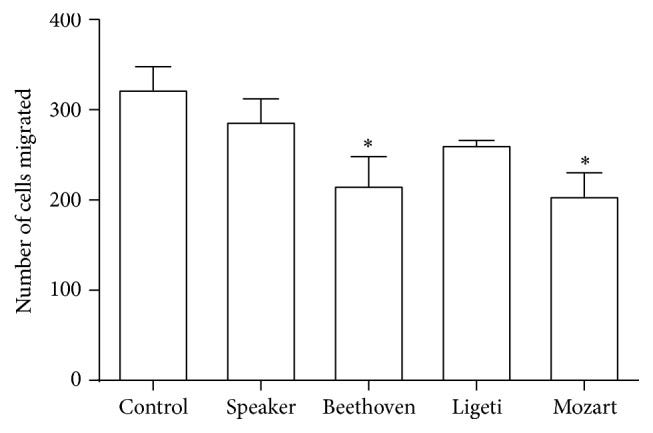
Beyond setting a mood, certain music has real positive impacts on our mind and body. Certain songs can lower cortisol levels and boost our reasoning skills. A 2016 research paper revealed how certain frequencies of music can also inhibit cancer growth and have a measurable affect on cell migration.
…both Beethoven's 5th Symphony and Mozart's sonata significantly diminished the migration of MDA-MB-231 (breast cancer) cells.1
This song, “Weightless” by Marconi Union, “resulted in a striking 65 percent reduction in participants’ overall anxiety, and a 35 percent reduction in their usual physiological resting rates.”, accoring to MindLab International, a company who has explored how music can affect consumer behaviour.2
If we must be subjected to consistent sound, we could be doing it in a more productive and pleasant way.

Song selection matters. It goes beyond setting the scene. A project in Montreal called “Musikiosk” did an interesting study where they placed speakers with an audio jack in a public park, allowing people to listen to whatever they wished. Not only does this provide park-goers the freedom to enjoy music fit for their mood in the moment, but it also placed responsibility upon them to make a selection suitable for their activity and environment.3 In turn, users filled out a questionnaire and the findings showed, “that the installation had a favorable effect on the utilization and ownership of public space.” How refreshing: we ought to be more trusted with an aux cord wherever we may be, rather than being dictated how to feel by a venue’s song selection.
Music manipulates mood.
A lot more goes into this than we might initially suspect. Music drives mood and can influence behaviour. This is why a store like Zara prefers four on the floor house music - it feels like a party. It lowers inhibition and creates this sense that you are in the spot. Spending money there makes you feel as if you can bring some of that party with you. When I enter into one of my favourite local cafés, it’s usually got a folksy vibe - Noah Kahan, a little Bon Iver…music usually associated with colder weather. The singer-songwriter genre usually wears emotion on its sleeve and can be intellectually driven at times. They cater to the college crowd in my town. It is all about the “vibe” that creates the desired effect: to feel cosy and spend your money on an overpriced hot beverage.
I worked as a barista in college and when I would open, would often choose a Classical playlist or something quieter. I would be able to quit my day job if I had a dollar for every time a customer told me it was “depressing” or asked me to change the disc. People notice if a public space is not conveying the aural aesthetic they expect and eventually, my manager told me to refrain from playing Classical altogether because it was driving people to spend less time in the store.

All that said, I find a world devoid of music in public spaces to be an unlikely one. So long as people respond to that vibe cue of whatever playlist is on by spending money and time in an establishment, so too music will be ubiquitous. Also, I can admit that in some cases, music can set a realy enjoyable scene if chosen thoughtfully. I get a lot of enjoyment at concerts and sporting events too, which are certainly not quiet spaces.
Still, you shouldn’t have trouble conversing with a friend over a cup of coffee or have to drown out the café music to read. These spaces were made for quieter surroundings.
Noise ordinances and conscientiousness.
Music aside, the at times excessive noise of lawn appliances and machinery make me romantic for Switzerland's noise ordinances, which establish quiet hours. Typically, they fall between somewhere around 21/2200-07/0800 on weekdays and all day on Sundays and public holidays. A mid-day quiet hour also exists, between 1200-1300 on weekdays.
Even if not legislated, a bit of social awareness goes a long way: we could all trade out the leaf blower for a deck brush or wait until a more reasonable hour before mowing the lawn. In a more socially conscientious society we all could be a little more mindful and it would a go long way in preserving everybody’s peace.

Wanting a little bit more quiet in your daily life, be it at home or in public, is not unreasonable. It is understandable that more urban settings are simply louder, more brightly lit, and busier. If you choose to live in one, as I do, you should accept that. It is worth lamenting here though, the downside of incessant music or noise pollution, if for no other reason than to make everyone more aware of how it impacts us.
Many of us have household projects or social gatherings that can get loud and intrude on the peace of others from time to time, but I am asking that we simply take a more self-aware approach and come to see how the noise pollution of everyday life can detract from our enjoyment of an experience and make us feel like our mood should be geared differently.
There is enough stimulation in the world going to battle over our attention and mood. Adding to the noise of life gratuitously doesn’t do society any favours.
Lestard and Capella, “Exposure to Music Alters Cell Viability and Cell Motility of Human Nonauditory Cells in Culture”, 2016. https://pmc.ncbi.nlm.nih.gov/articles/PMC4960344/#ref-list1
Melanie Curtin, “Neuroscience Says Listening to This Song Reduces Anxiety by Up to 65 Percent”, 2017. https://www.inc.com/melanie-curtin/neuroscience-says-listening-to-this-one-song-reduces-anxiety-by-up-to-65-percent.html
Steele et al., Soundtracking the Public Space: Outcomes of the Musikiosk Soundscape Intervention”, 2019. https://pmc.ncbi.nlm.nih.gov/articles/PMC6571869/
Music is indeed powerful, it is an important form of storytelling, connecting ideas. I remember a few art exhibitions I attended at the Zürich Art Museum a few years ago, one on the concept of scapegoating. There were photographs displayed of victims of scapegoating in modern times, coupled with some text to share the context of their stories. However, the music (classical, with a sad tone) added to my whole experience, and I finished the exhibition in tears. On another note, I agree with the use of music in stores, I always dislike their playlists, the same in some cafés. I even choose revisiting a café based on the playlist they use—or the absence of it. Silence is, most of the time, much needed as well.
Fascinating bit about music. I wholeheartedly agree that this could be approached more consciously. Music is a powerful tool.